

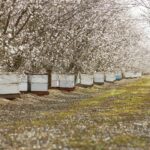
After watching bees at work in the fields, it feels right to step back inside the hive.
Over the past few weeks we’ve followed honey from flower to jar and learned why real honey crystallizes. We slowed down to understand bee pollen for what it actually is, not what it’s often marketed to be. We even lingered on the quiet mechanics of plant reproduction that make both honey and pollen possible. Most recently we followed bees far beyond the hive as agricultural workers, pollinating vast landscapes not of their choosing. But none of that outward labor exists without something steadier and more deliberate happening inside the hive itself.
Inside the hive, priorities are different. Honey is stored as food for the colony. Pollen is gathered, packed, and transformed to nourish developing bees. These are shared resources produced in abundance and meant to sustain many. Royal jelly belongs to a different category altogether. It is not stored. It is not abundant. It is a fresh, metabolically costly secretion produced by nurse bees and used sparingly at very specific moments in the life of the colony.
Royal jelly is often described as the food of a queen, but that shorthand misses something important. All larvae receive royal jelly briefly at the start of life. Only a few continue to receive it, and that difference shapes everything that follows. This is not about luxury or excess. It is about allocation. Royal jelly is how a hive determines continuity, leadership, and survival. It is produced fresh and used immediately because the bees require it.
Lately we’ve been asked about royal jelly more and more, often in the context of supplements or social media trends. That curiosity is understandable. Humans tend to notice what is rare, powerful, and difficult to obtain. But fascination can easily flatten context. When something is removed from the system that gave it meaning, it becomes easy to misunderstand what it was actually for.
Royal jelly is not harvested the way honey is. It is not produced in surplus and it is not something bees are trying to offer. Commercial production relies on repeated queen rearing and collecting the jelly early, before a queen can fully develop. Much of the global supply comes from large-scale operations overseas where freshness, handling, and consistency are difficult for the end consumer to verify. Like many hive products that drift into the supplement space, hype often travels faster than clarity.
We’re also sometimes asked whether royal jelly is already present in honey. Honey is a complete food in its own right, created by bees to sustain the colony through scarcity. Royal jelly, by contrast, is produced fresh and used immediately for a very specific purpose. If trace amounts ever appear in honey, they are incidental, not concentrated, and not something bees are intentionally providing. These substances serve different roles inside the hive.
For us the line is simple. We don’t separate, concentrate, or sell royal jelly, not because it lacks intrigue, but because it does not belong to the category of foods the hive makes for sharing. Honey does. Pollen does. Royal jelly serves a different purpose entirely, one that only makes sense inside the system that produces it.
Next time we’ll close this series by widening the lens one last time and looking at what happens once honey leaves the hive and enters the larger human world that surrounds it. If you’ve found value in this series so far, we’d be grateful if you shared it with someone who’s curious too.
Bee well,
Brenna & Kenny


1 Comment
Many thanks, I love this series!