

This newsletter begins a short educational series we will be sharing over the coming weeks focused on bees, honey, pollen, and seasonal allergies. These are topics we talk about at the market every weekend, often one question at a time. Our goal with this series is to step back and offer clearer context. What bees actually do. What real honey is. How pollen works. And why so much confusion exists around these foods in the first place.
One of the most common questions we hear about honey is also one of the simplest to answer. Why did it turn solid? Has it gone bad? Is it sugared up? The short answer is no. The longer and more interesting answer is that crystallization is exactly what real honey does.
Honey is a supersaturated solution of natural sugars, primarily fructose and glucose. Glucose is less soluble than fructose, so over time it naturally separates and forms crystals. Raw honey still contains pollen, enzymes, and microscopic wax particles, all of which give those crystals a place to form. Nothing has been added. Nothing has gone wrong. The honey has simply shifted form.
This is also why crystallization is such a strong indicator that honey is raw. Most grocery store honey has been heated aggressively and filtered to remove pollen and other solids. That processing delays crystallization but at the cost of enzymes and biological activity. When honey never crystallizes, it is often because something has been done to it. When honey does crystallize, it is behaving exactly as nature intended.
Honey is also remarkably long lived. Immortal is not an exaggeration. Archaeologists have found honey in ancient tombs that was still edible thousands of years later. Honey’s low moisture content, natural acidity, and antibacterial properties make it one of the few foods that truly does not spoil under normal conditions. Crystallization is not a sign of age or decline. It is simply a phase.
It is also worth remembering that honey is not table sugar. Table sugar is refined sucrose, stripped of context and nutrients. Honey is a whole food. Its sugar structure is closer to that of fruit, primarily fructose and glucose, already transformed by bees. Along with sweetness, honey contains enzymes, organic acids, trace minerals, antioxidants, and pollen compounds unique to its floral source. Many people experience honey very differently in their bodies than refined sugar because it arrives with far more information than sweetness alone.
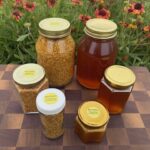
If you prefer your honey liquid, it can be gently returned to that state without damaging it. Bring a pot of water to a boil, turn off the burner, and set the entire jar of honey into the hot water. Let it sit for at least twenty minutes, longer for a fully crystallized jar. Stir occasionally if possible. The honey will slowly reliquefy. It will crystallize again over time, because that is what real honey does. Please never heat honey in the microwave, that kills all the benefits of real raw honey.
Crystallized honey is also wonderful to use just as it is. Stir it into coffee or tea and it melts instantly. Spread it on toast, biscuits, or sourdough where it stays put instead of dripping onto the plate. Spoon it onto yogurt, oatmeal, or cottage cheese for a slow dissolving sweetness. It works beautifully in vinaigrettes where the crystals dissolve as you whisk, and it is excellent for baking when you want sweetness without excess moisture.
As we move through this series, our hope is to replace a little confusion with understanding. Bees matter. Honey matters. Pollen matters. And misinformation spreads far more easily than truth. If this was helpful, please share it with a friend, a family member, or anyone who has ever hesitated over a crystallized jar of honey. Education around bees and their foods benefits all of us.
Next time, we will turn our focus to bee pollen. What it is, how it is collected, why it matters nutritionally, and how to use it thoughtfully. We will also talk about Power Honey, our honey and pollen blend, and why bringing these two foods back together can be such a natural fit, especially during seasonal transitions. Curious about bee pollen? Start here!
Stay well fed,
Brenna & Kenny

1 Comment
Thank you for this great information!